
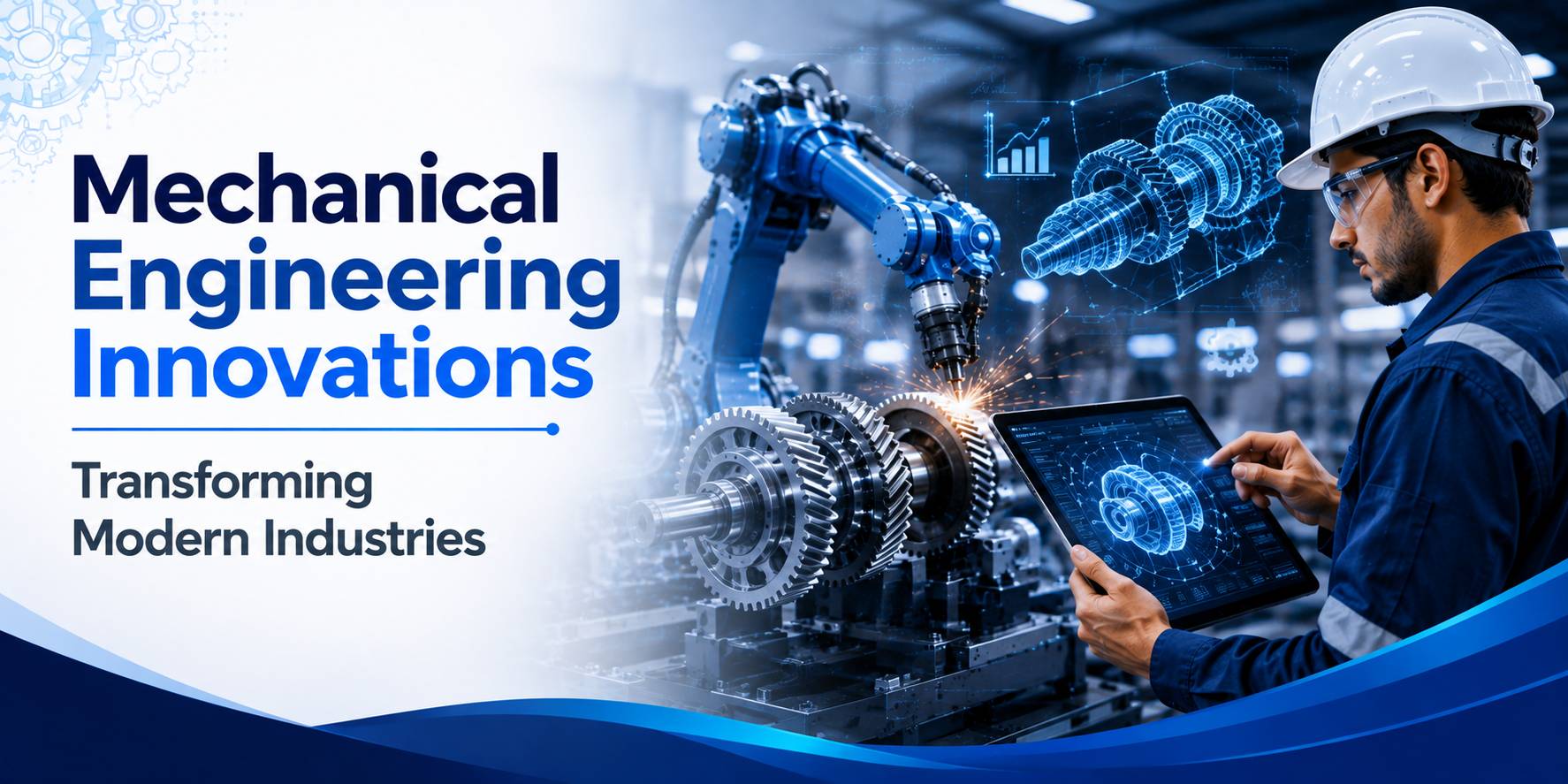
Mechanical engineering has always played an important role in industrial development. From designing machines and manufacturing equipment to developing automobiles, power systems and advanced industrial products, mechanical engineers contribute to many technologies people use every day.
However, the field is changing rapidly. Artificial Intelligence (AI), robotics, 3D printing, advanced materials and digital technologies are introducing new ways to design, manufacture and maintain machines.
These developments are making industries more automated, efficient and connected. They are also expanding the responsibilities of mechanical engineers, who increasingly work alongside professionals from computer science, electronics and other engineering disciplines.
Understanding these Mechanical Engineering Innovations can help students recognise how the discipline is evolving and what skills may be valuable for their future careers.
What Is Driving Innovation in Mechanical Engineering?
Modern industries face several challenges, including the need to improve production efficiency, reduce operating costs, maintain product quality and use resources responsibly.
Mechanical engineering innovations help address these challenges through improved machines, manufacturing methods and engineering systems.
Some major factors driving this transformation include:
-
Automation: Industries are adopting automated equipment to improve production consistency and efficiency.
-
Digital Technologies: Sensors, software and connected systems help monitor industrial operations.
-
Artificial Intelligence: AI-based tools support equipment monitoring, design optimisation and manufacturing decisions.
-
Sustainability: Industries are exploring energy-efficient systems, alternative materials and cleaner production methods.
-
Advanced Manufacturing: Technologies such as additive manufacturing are changing how complex components are produced.
10 Mechanical Engineering Innovations Transforming Modern Industries
1. Industrial Robotics and Collaborative Robots
Robotics has become an important part of modern manufacturing. Industrial robots perform repetitive, physically demanding and precision-based tasks in production environments.
They are used for welding, painting, material handling, assembly and quality inspection.
Collaborative robots, also known as cobots, are designed to work alongside human operators in suitable applications with appropriate safety systems.
Industrial Applications:
-
Automobile manufacturing
-
Electronics assembly
-
Material handling
-
Packaging and inspection
-
Precision manufacturing
Robotics is changing how manufacturing facilities organise production, while creating opportunities for engineers who understand mechanical systems, automation and control technologies.
2. 3D Printing and Additive Manufacturing
Traditional manufacturing often involves cutting, drilling or shaping material to produce a component. Additive manufacturing follows a different approach by creating objects layer by layer from a digital design.
Commonly known as 3D printing, this technology allows manufacturers to produce complex shapes and prototypes with greater design flexibility.
Industrial Applications:
-
Aerospace components
-
Automotive prototypes
-
Medical devices
-
Customised machine parts
-
Product development
One major advantage is the ability to produce certain complex components without requiring conventional tooling. However, material properties, production speed, cost and quality requirements still determine whether additive manufacturing is suitable for a particular application.
3. Artificial Intelligence in Mechanical Engineering
Artificial Intelligence is becoming increasingly useful in mechanical engineering and industrial operations.
AI-based systems can analyse large volumes of equipment and production data to identify patterns, support maintenance decisions and improve manufacturing processes.
For example, machine learning models can analyse vibration and temperature readings to identify signs of possible equipment problems.
Industrial Applications:
-
Predictive maintenance
-
Quality inspection
-
Production planning
-
Equipment performance analysis
-
Engineering design optimisation
The combination of mechanical engineering knowledge and AI is creating opportunities for interdisciplinary innovation.
4. Digital Twin Technology
A digital twin is a virtual representation of a physical product, machine or industrial system. It can use data from sensors and other sources to reflect the condition or behaviour of the real-world system.
Engineers can use digital twins to study performance, test different operating conditions and identify possible improvements.
Industrial Applications:
-
Manufacturing equipment monitoring
-
Aircraft engine analysis
-
Industrial plant management
-
Product design and testing
-
Infrastructure and energy systems
Digital twin technology can help engineers understand how a system behaves before making changes to the physical equipment.
5. Internet of Things (IoT) in Smart Manufacturing
The Internet of Things connects physical devices through sensors, networks and software. In manufacturing, connected machines can collect and exchange operational information.
This supports better visibility into production activities and equipment performance.
Industrial Applications:
-
Real-time machine monitoring
-
Inventory tracking
-
Energy consumption monitoring
-
Production management
-
Equipment maintenance
For mechanical engineers, understanding sensors, automation and connected systems is becoming increasingly useful in modern industrial environments.
6. Advanced Materials and Lightweight Engineering
Material innovation is another important area of mechanical engineering. Industries are exploring advanced materials to improve strength, durability, weight and performance.
Examples include carbon-fibre composites, advanced alloys, ceramics and specialised polymers.
Industrial Applications:
-
Lightweight automotive components
-
Aerospace structures
-
Industrial machinery
-
Medical equipment
-
High-performance engineering products
Lightweight materials can help reduce the weight of vehicles and equipment, although their selection depends on strength, cost, manufacturing requirements and operating conditions.
7. Electric Vehicles and Advanced Powertrain Systems
The development of electric vehicles is creating new engineering challenges and opportunities.
Mechanical engineers contribute to several areas of vehicle development, including thermal management, structural design, battery enclosures, cooling systems and component integration.
Important Areas of Innovation:
-
Battery thermal management
-
Electric motor design
-
Vehicle cooling systems
-
Lightweight structures
-
Powertrain integration
Electric vehicle development also requires collaboration between mechanical, electrical and electronics engineers.
8. Advanced CNC Machining and Smart Manufacturing
Computer Numerical Control (CNC) machining uses computer-controlled instructions to operate manufacturing tools with precision.
Modern CNC systems can be integrated with computer-aided design and manufacturing software to improve production planning and component accuracy.
Industrial Applications:
-
Automotive component manufacturing
-
Aerospace engineering
-
Precision machine parts
-
Tool and die production
-
Industrial equipment manufacturing
The combination of CNC machining, automation and digital design is helping manufacturers produce complex components more consistently.
9. Renewable Energy and Energy-Efficient Mechanical Systems
The transition towards more sustainable energy systems is creating new areas of work for mechanical engineers.
Mechanical engineering principles are used in wind turbines, hydropower equipment, solar thermal systems, heat pumps and energy-efficient industrial machinery.
Industrial Applications:
-
Wind turbine design
-
Solar thermal systems
-
Industrial heat recovery
-
Energy-efficient HVAC systems
-
Sustainable power generation
Engineers working in this area focus on improving energy performance, system reliability and resource utilisation.
10. Sustainable Manufacturing and Circular Engineering
Modern industries are increasingly considering the environmental impact of product design, manufacturing and disposal.
Sustainable manufacturing focuses on reducing waste, improving resource efficiency and making better use of materials throughout a product's life cycle.
Key Practices Include:
-
Recycling and reusing materials
-
Reducing manufacturing waste
-
Improving energy efficiency
-
Designing products for repair and reuse
-
Optimising production processes
Mechanical engineers play an important role in developing products and manufacturing systems that balance performance, cost and environmental considerations.
How Mechanical Engineering Innovations Are Changing Different Industries
The impact of mechanical engineering extends across several industrial sectors.
|
Industry |
Major Innovations |
Practical Impact |
|
Automobile |
Electric vehicles, lightweight materials, automation |
Improved vehicle design and manufacturing |
|
Aerospace |
Advanced composites, additive manufacturing, digital twins |
Lightweight components and design optimisation |
|
Healthcare |
Medical devices, precision equipment, 3D printing |
More specialised engineering solutions |
|
Manufacturing |
Robotics, CNC machining, smart sensors |
Improved production monitoring and consistency |
|
Energy |
Wind turbines, heat recovery, efficient machinery |
Better energy utilisation |
|
Construction |
Advanced machinery, automation, material innovation |
More efficient equipment and processes |
These developments demonstrate that mechanical engineering is not limited to traditional machines. It is closely connected with emerging technologies and modern industrial systems.
Skills Required for Future Mechanical Engineers
As the industry evolves, mechanical engineering students need a combination of fundamental engineering knowledge and practical technical skills.
Some useful areas to explore include:
1. Computer-Aided Design (CAD): Learn how to create and modify engineering drawings and 3D models.
2. Manufacturing Technology: Understand machining, production processes, material selection and quality control.
3. Robotics and Automation: Develop an understanding of robotic systems, sensors and industrial control.
4. Programming Fundamentals: Basic programming knowledge can help engineers work with simulation, automation and data analysis tools.
5. Thermal and Fluid Sciences: Build a strong foundation in thermodynamics, heat transfer and fluid mechanics.
6. Problem-Solving and Teamwork: Modern engineering projects often involve multidisciplinary teams, making communication and analytical thinking important.
Students should combine theoretical learning with practical projects, laboratory work and industry exposure wherever possible.
Career Opportunities in Modern Mechanical Engineering
The development of new technologies is expanding the range of career opportunities available to mechanical engineering graduates.
Depending on qualifications, technical skills and experience, students can explore roles such as:
-
Mechanical Design Engineer: Develops mechanical components, products and equipment.
-
Manufacturing Engineer: Works on production processes, machinery and manufacturing efficiency.
-
Automation Engineer: Supports the development and operation of automated industrial systems.
-
Robotics Engineer: Works with robotic equipment, mechanical design and control systems.
-
Automotive Engineer: Contributes to vehicle design, testing and component development.
-
Thermal Engineer: Works with heat transfer, cooling and energy systems.
-
Quality Control Engineer: Evaluates products and processes against engineering standards.
-
Maintenance Engineer: Helps maintain machinery and improve equipment reliability.
The skills and qualifications required vary depending on the organisation and job role. Some specialised positions may also require postgraduate education or additional technical training.
Study Mechanical Engineering at SurTech, Kolkata
For students interested in understanding machines, manufacturing systems, product design and emerging industrial technologies, choosing an appropriate engineering programme is an important step.
Dr. Sudhir Chandra Sur Institute of Technology & Sports Complex (SurTech), Kolkata, offers a B.Tech programme in Mechanical Engineering. The institute's Mechanical Engineering Department focuses on engineering fundamentals, practical learning and exposure to modern technologies.
The department's published laboratory facilities include:
-
Applied Mechanics Laboratory
-
Material Testing Laboratory
-
Fluid Mechanics and Hydraulic Machines Laboratory
-
Applied Thermodynamics and Heat Transfer Laboratory
-
Dynamics of Machines Laboratory
-
Machining and Machine Tools Laboratory
-
Advanced Manufacturing Technology Laboratory
-
CAD (Design) Laboratory
-
IC Engine Laboratory
These areas support the practical study of mechanical engineering concepts and manufacturing processes.
Students can explore the B.Tech in Mechanical Engineering programme and learn more about the Department of Mechanical Engineering.
Conclusion
Mechanical engineering continues to evolve through innovations in robotics, additive manufacturing, artificial intelligence, electric vehicles, advanced materials and smart manufacturing.
These technologies are changing how industries design products, operate machinery and manage production systems. At the same time, they are creating opportunities for engineers who can combine traditional mechanical engineering knowledge with modern technical skills.
For students considering a career in this field, understanding these developments is a useful starting point. A strong foundation in engineering principles, practical learning and continuous skill development can help prepare them to contribute to the next generation of industrial innovation.
Frequently Asked Questions (FAQs)
1. What are the latest innovations in mechanical engineering?
Important areas of innovation include industrial robotics, 3D printing, artificial intelligence, digital twins, IoT-based monitoring, advanced materials, electric vehicle technology and sustainable manufacturing.
2. How is AI used in mechanical engineering?
AI is used in areas such as predictive maintenance, manufacturing quality inspection, production optimisation and engineering design analysis. It helps engineers analyse data and support technical decisions.
3. What is the role of robotics in modern manufacturing?
Robotics helps automate tasks such as welding, assembly, painting, material handling and inspection. It can improve production consistency and support operations in environments that may be difficult or repetitive for human workers.
4. Is mechanical engineering still a good career option?
Mechanical engineering remains relevant across manufacturing, automotive, aerospace, energy, infrastructure and other sectors. Career opportunities depend on qualifications, practical experience and technical specialisation.
5. What skills should mechanical engineering students learn?
Students should develop knowledge of engineering mechanics, thermodynamics, manufacturing processes, CAD, material science and machine design. Familiarity with automation, robotics and programming can also be useful.
6. What career opportunities are available after B.Tech in Mechanical Engineering?
Graduates can explore roles in mechanical design, manufacturing, quality control, maintenance, automotive engineering, thermal engineering and industrial automation, depending on their skills and qualifications.