
Artificial Intelligence (AI) is becoming an important part of modern technology. From voice assistants and online recommendations to advanced medical research and automated manufacturing systems, AI is changing how people interact with technology and how businesses operate.
What was once considered an advanced concept in computer science is now being applied across several industries. Organisations are using AI to analyse information, automate repetitive activities, improve customer experiences and support decision-making.
As businesses continue exploring new AI applications in 2027, understanding this technology is becoming increasingly valuable for students, engineers and working professionals. It is also creating opportunities for people interested in computer science, data science, robotics and emerging technologies.
This article explores how Artificial Intelligence is transforming different industries, its practical applications and the skills students can develop to prepare for a technology-driven future.
What Is Artificial Intelligence?
Artificial Intelligence is a branch of computer science that focuses on developing systems capable of performing tasks that typically require human intelligence. These tasks may include understanding language, recognising images, analysing information, identifying patterns and making predictions.
AI systems use different technologies and techniques to perform these activities.
Some important areas of Artificial Intelligence include:
-
Machine Learning: Enables computer systems to learn patterns from data and improve their performance.
-
Deep Learning: Uses multi-layered neural networks to process complex information.
-
Natural Language Processing (NLP): Helps computers understand, interpret and generate human language.
-
Computer Vision: Allows machines to analyse and interpret images and videos.
-
Generative AI: Creates new content such as text, images, audio and computer code.
-
Robotics: Combines computing, sensors and mechanical systems to perform physical tasks.
These technologies are increasingly being combined to develop intelligent applications for real-world problems.
How Artificial Intelligence Is Transforming Different Industries in 2027
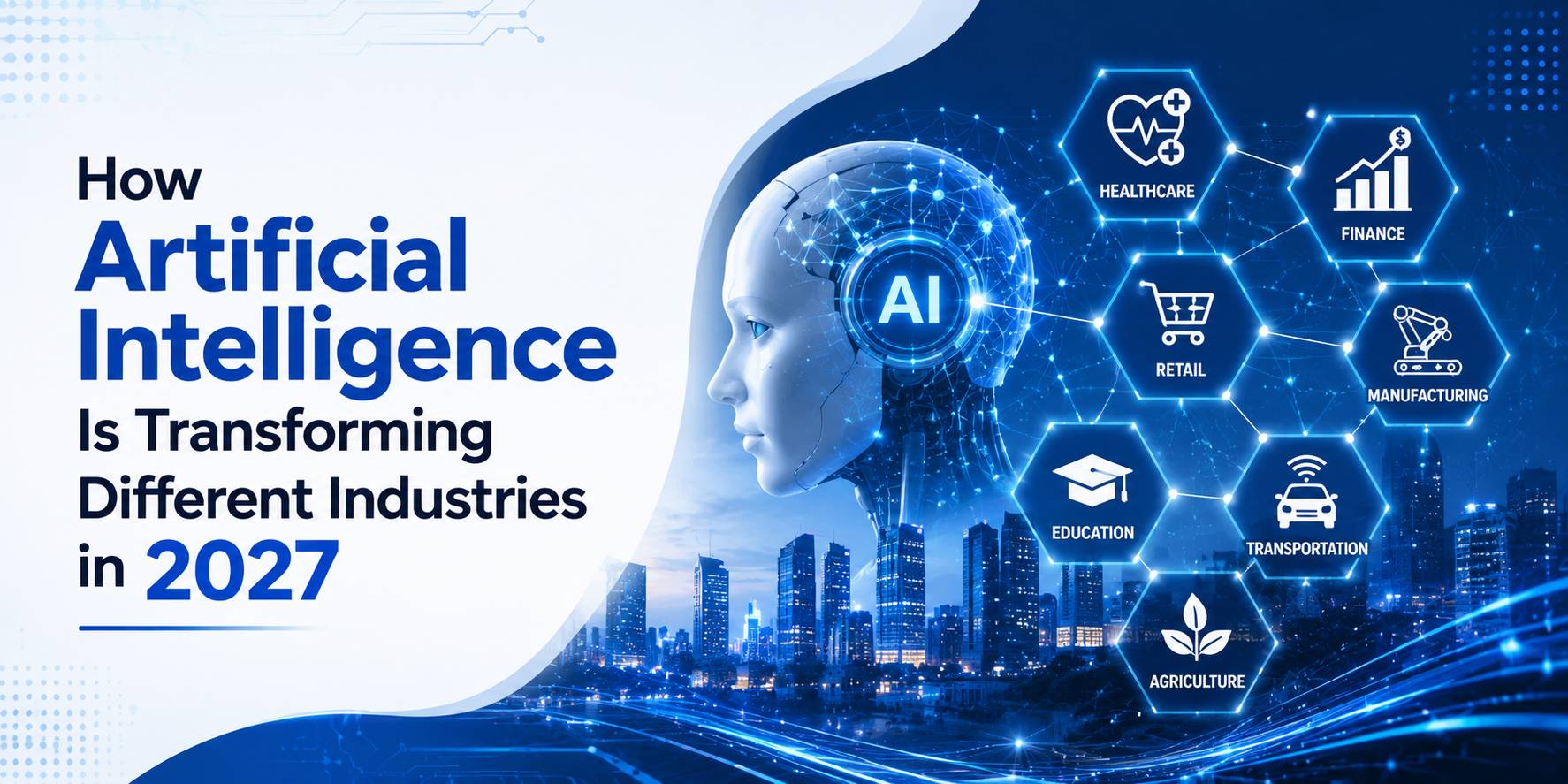
The impact of AI is not limited to the IT sector. Its applications are expanding across healthcare, manufacturing, education, finance, transportation and several other industries.
Here are some important areas where AI is making a difference.
1. Healthcare and Medical Research
Healthcare is one of the important areas where Artificial Intelligence is supporting research, clinical workflows and medical technology.
AI-powered systems can analyse medical images, identify patterns in health records and support research into disease detection. They can also help healthcare organisations manage administrative tasks and organise patient information.
Key Applications:
-
Medical image analysis
-
Clinical data analysis
-
Drug discovery research
-
Remote patient monitoring
-
Hospital workflow management
-
Predictive healthcare research
For example, computer vision systems can assist researchers in examining medical images such as X-rays and MRI scans. Machine Learning can also help identify patterns in large healthcare datasets.
However, AI-generated findings require appropriate clinical validation and professional supervision. AI systems are tools to support healthcare professionals, not replacements for medical judgement.
2. Manufacturing and Industrial Automation
Manufacturing industries are increasingly exploring AI to improve production processes, product quality and equipment management.
AI-powered systems can analyse information collected from industrial machines and sensors. This helps manufacturers identify unusual operating patterns and plan maintenance before certain equipment problems become serious.
Key Applications:
-
Predictive maintenance
-
Automated quality inspection
-
Industrial robotics
-
Production planning
-
Supply chain optimisation
-
Smart factory management
For instance, an AI-based inspection system can examine product images to identify visible defects during manufacturing. Predictive maintenance systems can analyse machine performance data to help estimate when servicing may be required.
The combination of AI, robotics, sensors and automation is an important part of the development of smart manufacturing systems.
3. Banking and Financial Services
Financial institutions handle large volumes of transactions and customer information. Artificial Intelligence can help analyse this data and identify patterns that may be difficult to detect through manual processes.
Banks and financial service providers are exploring AI for operational efficiency, risk analysis and customer support.
Key Applications:
-
Fraud detection
-
Credit risk assessment
-
Customer service chatbots
-
Transaction monitoring
-
Financial forecasting
-
Document processing
For example, Machine Learning models can analyse transaction patterns and flag activities that require further investigation.
AI can support financial decision-making, but sensitive decisions involving credit, compliance and customer accounts require appropriate human oversight and regulatory controls.
4. Education and E-Learning
Artificial Intelligence is changing how educational content is created, delivered and accessed. Digital learning platforms can use AI to support personalised learning experiences and provide students with additional academic assistance.
Key Applications:
-
AI-powered learning assistants
-
Personalised study recommendations
-
Automated assessment support
-
Language learning tools
-
Educational content development
-
Student performance analysis
For example, an AI-powered learning platform may recommend additional practice materials based on a student's progress.
Teachers and educational institutions can also use AI tools to support lesson preparation and administrative work. However, academic integrity, student privacy and the accuracy of AI-generated information remain important considerations.
5. Agriculture and Smart Farming
Agriculture is another sector where AI can support better planning and resource management. Farmers and agricultural researchers can use data from sensors, satellites, weather systems and agricultural equipment to understand field conditions.
Key Applications:
-
Crop monitoring
-
Soil condition analysis
-
Pest and disease identification
-
Weather-based planning
-
Smart irrigation
-
Agricultural yield estimation
For example, image recognition technology can help identify visible signs of crop disease from photographs. AI-based systems can also analyse environmental information to support irrigation planning.
Combining AI with drones, sensors and Internet of Things (IoT) technology can create new possibilities for precision agriculture.
6. Transportation and Logistics
Transportation and logistics companies manage complex operations involving vehicles, routes, delivery schedules and supply chains. AI can help analyse operational data and support more efficient planning.
Key Applications:
-
Route optimisation
-
Traffic prediction
-
Fleet management
-
Delivery planning
-
Autonomous vehicle research
-
Supply chain forecasting
For example, logistics platforms can use AI-based systems to evaluate traffic conditions and suggest alternative delivery routes.
In transportation research, AI is also used in advanced driver-assistance systems and autonomous vehicle development. These technologies require extensive testing, safety validation and regulatory compliance before deployment.
7. Retail and E-Commerce
Online shopping platforms use AI to understand customer preferences, analyse product demand and improve digital shopping experiences.
Recommendation systems are among the most familiar examples of AI in retail.
Key Applications:
-
Product recommendations
-
Customer behaviour analysis
-
Inventory management
-
Demand forecasting
-
Visual product search
-
Customer support chatbots
For example, an e-commerce platform may recommend products based on browsing history, previous purchases and similar customer preferences.
Retail businesses can also use AI to estimate product demand and support inventory planning. Responsible use of customer data and privacy protection remain essential.
8. Energy and Renewable Power
Energy companies are exploring AI to improve electricity management, monitor infrastructure and support renewable energy operations.
As solar and wind energy become important parts of energy systems, forecasting and efficient resource management are increasingly relevant.
Key Applications:
-
Electricity demand forecasting
-
Smart grid management
-
Renewable energy prediction
-
Equipment monitoring
-
Energy consumption analysis
-
Predictive maintenance
For example, AI models can analyse weather information and historical generation data to estimate solar power availability.
AI can also help identify unusual patterns in energy infrastructure, supporting maintenance planning and operational monitoring.
9. Construction and Infrastructure
The construction industry is gradually adopting digital technologies to improve project planning, site monitoring and infrastructure management.
AI can analyse project information, engineering data and visual records to support different stages of construction.
Key Applications:
-
Project scheduling
-
Construction site monitoring
-
Structural health monitoring
-
Design optimisation
-
Equipment management
-
Safety risk identification
For example, computer vision systems can analyse site images to identify certain safety risks or monitor construction progress.
AI can also support structural engineering research by helping analyse sensor data from bridges and buildings. Engineering expertise and physical inspections remain essential for safety-critical decisions.
10. Cybersecurity and Information Technology
As businesses become more dependent on digital systems, protecting networks, applications and sensitive information is increasingly important.
AI can help cybersecurity professionals analyse large volumes of security information and identify unusual activities.
Key Applications:
-
Threat detection
-
Network monitoring
-
Spam and phishing identification
-
Malware analysis
-
User behaviour analysis
-
Security incident prioritisation
For example, Machine Learning models can identify unusual login patterns or network activity that may indicate a security threat.
However, cybercriminals can also misuse AI to create more convincing phishing messages and automate attacks. This makes cybersecurity knowledge and responsible AI development particularly important.
Benefits of Artificial Intelligence Across Industries
Although AI applications differ from one industry to another, several benefits are common across sectors.
1. Improved Efficiency: AI can automate repetitive activities and help organisations complete certain tasks more efficiently.
2. Data-Based Decision-Making: AI systems can analyse large datasets and identify patterns that support planning and decision-making.
3. Better Customer Experience: Personalised recommendations and intelligent support systems can make digital services more responsive.
4. Predictive Capabilities: AI models can use historical and current data to estimate possible future outcomes.
5. Innovation and Research: AI can support researchers and engineers in exploring complex problems and developing new solutions.
6. Resource Optimisation: AI can help organisations manage equipment, energy, inventory and other resources more effectively.
The actual benefits depend on the quality of data, the suitability of the technology and how responsibly it is implemented.
Challenges of Artificial Intelligence in 2027
Despite its potential, AI adoption also comes with challenges. Understanding these limitations is important for students and professionals who want to work with intelligent technologies.
Some major challenges include:
-
Data Privacy: AI systems may process sensitive personal or business information, requiring strong data protection practices.
-
Algorithmic Bias: Incomplete or biased training data can lead to unfair or inaccurate outcomes.
-
Cybersecurity Risks: AI systems can introduce new security vulnerabilities and may also be misused by attackers.
-
Implementation Costs: Developing and maintaining AI systems can require significant investment in computing infrastructure and skilled professionals.
-
Accuracy and Reliability: AI-generated results may contain errors and require verification.
-
Workforce Adaptation: Employees may need to develop new technical and analytical skills as job responsibilities evolve.
Responsible AI development requires transparency, human oversight, security testing and continuous evaluation.
Career Opportunities in Artificial Intelligence
The expansion of AI across industries is creating opportunities in software development, research, engineering, analytics and cybersecurity.
Students interested in this field can explore career paths such as:
|
Career Role |
Main Area of Work |
|
AI Engineer |
Developing and integrating AI-powered applications |
|
Machine Learning Engineer |
Building and deploying Machine Learning models |
|
Data Scientist |
Analysing data and developing predictive models |
|
Data Analyst |
Interpreting information to support business decisions |
|
Robotics Engineer |
Developing intelligent robotic systems |
|
Computer Vision Engineer |
Building systems that interpret images and videos |
|
NLP Engineer |
Developing applications that process human language |
|
AI Researcher |
Exploring new methods and applications of Artificial Intelligence |
|
AI Security Specialist |
Studying security risks in AI systems and applications |
The educational requirements vary by role. A strong foundation in programming, mathematics, statistics, data structures and problem-solving can help students prepare for advanced learning in these areas.
Skills Students Should Develop for an AI-Driven Future
Students who want to explore Artificial Intelligence should focus on building both technical knowledge and practical problem-solving abilities.
Some useful skills include:
1. Programming: Learn programming fundamentals using languages such as Python, Java and C++.
2. Mathematics and Statistics: Understand probability, linear algebra, calculus and statistical concepts used in AI.
3. Data Science: Learn how to collect, clean, organise and analyse data.
4. Machine Learning: Understand how algorithms learn from data and make predictions.
5. Deep Learning: Explore neural networks and their applications in image, speech and language processing.
6. Problem-Solving: Practise applying technical knowledge to real-world challenges.
7. Ethical and Responsible AI: Understand data privacy, fairness, transparency and the limitations of AI-generated results.
Students should also work on practical projects, participate in technical workshops and stay updated with developments in the field.
Explore Artificial Intelligence and Machine Learning Education at SurTech
As Artificial Intelligence becomes relevant across engineering and technology sectors, students need opportunities to develop strong technical foundations and practical knowledge.
Dr. Sudhir Chandra Sur Institute of Technology & Sports Complex (SurTech) offers engineering education across multiple disciplines, including Computer Science and Engineering with a specialisation in Artificial Intelligence and Machine Learning.
The institute's CSE (AI & ML) department focuses on quality education, innovative research and technical development. Its academic and extracurricular activities include workshops, invited talks, seminars and industry visits.
Students can explore the following official pages to learn more:
Students interested in AI and emerging technologies can explore the programme details and admission information available on the official SurTech website.
Conclusion
Artificial Intelligence is changing how industries operate, make decisions and develop new technologies. From healthcare and manufacturing to education, agriculture, finance and transportation, AI is creating new possibilities for solving practical problems.
However, successful AI adoption requires more than advanced software. It also depends on reliable data, skilled professionals, responsible implementation and human judgement.
For students planning a future in engineering and technology, learning about Artificial Intelligence, Machine Learning, programming and data science can provide a valuable foundation. Developing these skills through academic learning and practical projects can help them understand the technologies shaping different industries in 2027 and beyond.
Frequently Asked Questions (FAQs)
1. What is Artificial Intelligence and how does it work?
Artificial Intelligence is a branch of computer science that develops systems capable of performing tasks such as learning, analysing information, recognising patterns and understanding language. It uses technologies such as Machine Learning, Deep Learning and Natural Language Processing.
2. Which industries are using Artificial Intelligence in 2027?
AI is being applied across healthcare, manufacturing, banking, education, agriculture, transportation, retail, energy, construction and cybersecurity. The level of adoption varies between industries and organisations.
3. How is Artificial Intelligence used in healthcare?
AI supports medical image analysis, healthcare data research, remote monitoring, drug discovery research and hospital administration. Its outputs require appropriate validation and professional oversight.
4. Which programming language is useful for Artificial Intelligence?
Python is widely used for AI and Machine Learning because of its libraries and development tools. Java and C++ are also useful in different software and engineering applications.
5. What career opportunities are available in Artificial Intelligence?
Students can explore careers such as AI Engineer, Machine Learning Engineer, Data Scientist, Robotics Engineer, Computer Vision Engineer and AI Researcher. The required qualifications depend on the specific role.
6. Can engineering students build a career in Artificial Intelligence?
Yes. Students with backgrounds in computer science, electronics and other engineering disciplines can explore AI through relevant coursework, programming practice, mathematics, projects and specialised training.