
Completing a Bachelor of Technology (B.Tech) is an important milestone for engineering students. However, graduation does not necessarily mean the end of academic learning. Many students choose to continue their education to develop specialised knowledge, explore management opportunities or prepare for research-oriented careers.
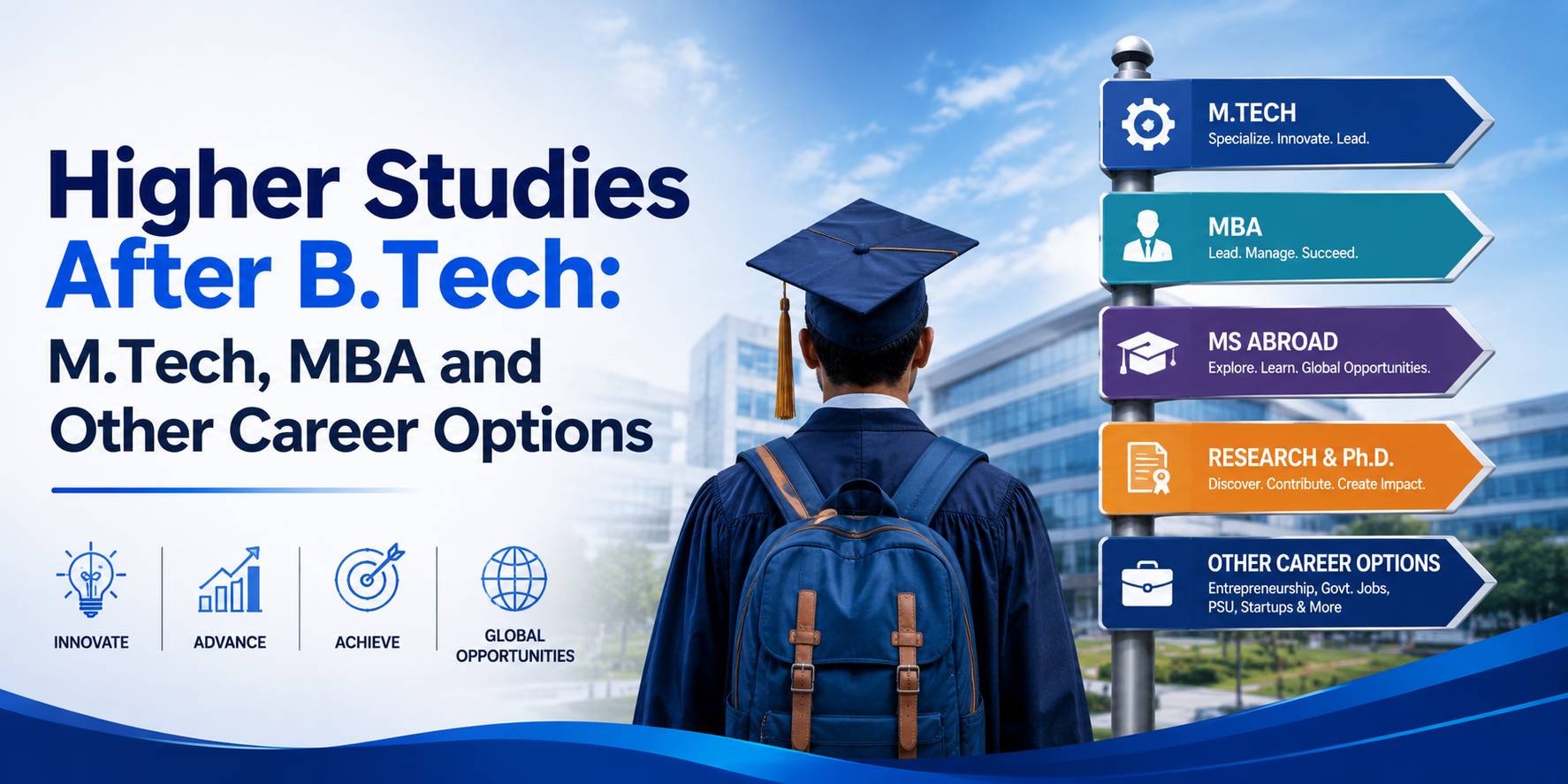
After B.Tech, students can consider several pathways, including M.Tech, MBA, MS abroad, postgraduate diplomas, professional certifications and research programmes. Each option offers a different learning experience and career direction.
But which course should you choose? Should you specialise in your engineering branch, move towards business management or explore an international degree?
Understanding the available options can help students make informed decisions. This guide explains the major opportunities for Higher Studies After B.Tech, along with entrance examinations, eligibility considerations and career prospects.
Why Should You Consider Higher Studies After B.Tech?
A B.Tech degree provides a foundation in engineering principles, technical knowledge and problem-solving. Higher education allows students to develop deeper expertise or move into a different professional field.
Some important reasons to pursue postgraduate education include:
-
Specialisation: Gain advanced knowledge in a particular engineering discipline or emerging technology.
-
Career Development: Prepare for specialised technical, managerial or research-oriented roles.
-
Research Opportunities: Explore innovation, product development and academic research.
-
Management Skills: Develop knowledge of business operations, finance, marketing and leadership.
-
International Exposure: Study in another country and experience different academic and professional environments.
-
Professional Growth: Build additional qualifications and skills relevant to long-term career goals.
However, higher studies are not compulsory for every engineering graduate. Students should consider their interests, career objectives, financial situation and the requirements of their preferred profession.
Top Higher Studies Options After B.Tech
There are several postgraduate pathways available after engineering graduation. The most suitable option depends on whether you want to continue in a technical field, enter management or explore interdisciplinary subjects.
1. M.Tech (Master of Technology)
M.Tech is one of the most common postgraduate choices for engineering graduates who want to develop advanced technical knowledge.
The programme generally focuses on a specialised area of engineering and includes advanced subjects, practical work and, depending on the institution, a dissertation or research project.
Popular M.Tech Specialisations:
-
Computer Science and Engineering
-
Artificial Intelligence and Machine Learning
-
Data Science
-
Mechanical Engineering
-
Structural Engineering
-
Electronics and Communication Engineering
-
Electrical Engineering
-
Cybersecurity
-
Manufacturing Technology
Entrance Examinations:
Students commonly explore:
-
GATE (Graduate Aptitude Test in Engineering)
-
State-level postgraduate engineering entrance examinations
-
Institution-specific admission tests
Admission requirements and accepted examination scores vary by university and specialisation.
Career Opportunities After M.Tech:
-
Research and Development Engineer
-
Design Engineer
-
Senior Software or Systems Engineer
-
Structural Design Engineer
-
Manufacturing Specialist
-
Technical Consultant
-
Research Associate
M.Tech can be a suitable option for students who want to deepen their technical expertise or explore research and development.
2. MBA (Master of Business Administration)
An MBA is an option for engineering graduates interested in business, management, leadership and organisational decision-making.
Engineering students often have analytical and problem-solving skills that can be useful in management roles. An MBA adds business knowledge and helps students understand how organisations operate.
Popular MBA Specialisations:
-
Marketing Management
-
Finance
-
Human Resource Management
-
Operations Management
-
Business Analytics
-
Information Technology Management
-
Supply Chain Management
-
International Business
Common Entrance Examinations:
-
CAT (Common Admission Test)
-
XAT (Xavier Aptitude Test)
-
CMAT (Common Management Admission Test)
-
MAT (Management Aptitude Test)
-
GMAT (Graduate Management Admission Test)
The accepted examinations and eligibility criteria depend on the institution.
Career Opportunities After MBA:
-
Business Analyst
-
Operations Manager
-
Marketing Manager
-
Project Manager
-
Financial Analyst
-
Product Manager
-
Management Consultant
An MBA may be suitable for students who want to move towards business strategy, management or leadership positions.
3. MS Abroad (Master of Science)
Students interested in international education can consider pursuing an MS degree at universities outside India.
An MS programme usually focuses on a specialised academic or technical subject. Depending on the university and course, students may choose research-based, coursework-based or professionally oriented programmes.
Popular MS Specialisations:
-
Computer Science
-
Data Science
-
Artificial Intelligence
-
Robotics
-
Mechanical Engineering
-
Electrical Engineering
-
Civil Engineering
-
Cybersecurity
-
Biotechnology
Common Admission Requirements:
Universities may consider:
-
A recognised bachelor's degree
-
Academic transcripts and CGPA
-
English-language proficiency tests such as IELTS or TOEFL
-
Statement of Purpose (SOP)
-
Letters of Recommendation (LOR)
-
GRE scores, where required
-
Research or project experience for relevant programmes
Requirements differ significantly between universities and countries. GRE scores are not mandatory for every programme.
Career Opportunities After MS:
Graduates may explore opportunities in research, engineering, software development, data science, product development and specialised technical roles, depending on their degree and local employment requirements.
4. Postgraduate Diplomas and Specialised Professional Courses
Students who want to develop job-oriented skills without pursuing a full-time postgraduate degree can explore postgraduate diplomas and specialised professional programmes.
These courses may focus on a particular technology, software platform or professional skill.
Popular Areas Include:
-
Artificial Intelligence and Machine Learning
-
Data Analytics
-
Cloud Computing
-
Cybersecurity
-
Full-Stack Development
-
Digital Manufacturing
-
Robotics and Automation
-
Project Management
-
Embedded Systems
Benefits:
-
Focused learning in a specialised subject
-
Opportunities to develop practical skills
-
Flexible learning formats in some programmes
-
Potential to strengthen an existing engineering qualification
Before enrolling, students should check the course provider, accreditation or recognition where applicable, curriculum, practical components and industry relevance.
5. PhD and Research Programmes
Students interested in academic research, scientific investigation and technological innovation can consider pursuing a PhD.
A PhD involves studying a specialised research problem, reviewing existing work, conducting investigations and contributing original findings to a particular field.
Popular Research Areas After B.Tech:
-
Artificial Intelligence
-
Robotics
-
Advanced Materials
-
Renewable Energy
-
Mechanical Design
-
Computer Science
-
Electronics and Communication
-
Structural Engineering
-
Manufacturing Technology
Many PhD programmes require a relevant postgraduate qualification, while certain institutions and disciplines also offer direct-entry or alternative pathways for eligible candidates. Admission requirements must be checked individually.
Career Opportunities:
-
Research Scientist
-
University Faculty Member
-
Research and Development Professional
-
Technical Researcher
-
Innovation Specialist
-
Academic Researcher
Students who enjoy experimentation, analysis and solving complex technical problems may find research-oriented education rewarding.
6. Government and Public Sector Career Preparation
Higher studies are not the only option after B.Tech. Engineering graduates can also prepare for competitive examinations and government-sector opportunities.
Some pathways include:
-
GATE: Used for admission to postgraduate engineering programmes and considered by certain public sector organisations during recruitment.
-
Engineering Services Examination (ESE): Conducted by UPSC for recruitment to specified engineering services, subject to eligibility.
-
State Public Service Examinations: Certain technical and administrative positions may be available through state-level recruitment.
-
Civil Services Examination: Engineering graduates can apply if they satisfy the applicable eligibility requirements.
-
Other Government Recruitment: Technical departments and public organisations may conduct examinations for engineering-related positions.
Examination patterns, vacancies, eligibility and recruitment rules can change. Students should refer to the latest official notifications before applying.
M.Tech vs MBA After B.Tech: Which Should You Choose?
One of the most common questions among engineering graduates is whether to pursue M.Tech or MBA.
Both are valuable postgraduate options, but they serve different professional interests.
|
Comparison Factor |
M.Tech |
MBA |
|
Main Focus |
Technical specialisation |
Business and management |
|
Learning Areas |
Advanced engineering, technology and research |
Finance, marketing, operations and leadership |
|
Suitable For |
Students interested in technical expertise |
Students interested in business and management |
|
Common Entrance Exams |
GATE and other accepted PG entrance tests |
CAT, XAT, CMAT, MAT and others |
|
Career Direction |
Engineering, research and technical roles |
Management, consulting and business roles |
|
Learning Approach |
Technical projects, specialised subjects and research |
Case studies, business projects and management learning |
Choose M.Tech if: You want to continue in your engineering discipline, gain advanced technical knowledge or explore research and development.
Choose MBA if: You are interested in business strategy, management, finance, marketing or leadership responsibilities.
Neither option is universally better. Your interests and long-term career plans should guide the decision.
Higher Studies Options Based on Your B.Tech Branch
Different engineering branches offer different postgraduate opportunities. Students can use their undergraduate specialisation as a starting point when exploring further education.
|
B.Tech Branch |
Possible Higher Studies Options |
|
Computer Science and Engineering |
M.Tech CSE, MS Computer Science, AI, Data Science, MBA |
|
Mechanical Engineering |
M.Tech Mechanical, Manufacturing, Robotics, MBA |
|
Civil Engineering |
M.Tech Structural Engineering, Construction Management, MS Civil Engineering |
|
Electrical Engineering |
M.Tech Electrical, Power Systems, Renewable Energy |
|
Electronics and Communication Engineering |
M.Tech ECE, VLSI, Embedded Systems, Communication Engineering |
|
Automobile Engineering |
M.Tech Automotive Engineering, Electric Vehicle Technology, Mechanical Engineering |
These are illustrative pathways. Admission eligibility depends on the specific postgraduate programme and the student's undergraduate subjects and qualifications.
How to Choose the Right Higher Studies Programme After B.Tech
Selecting a postgraduate programme requires careful planning. Instead of choosing a course only because it is popular, consider the following factors.
1. Identify Your Career Goals
Decide whether you want to become a technical specialist, researcher, manager, entrepreneur or government-sector professional.
2. Evaluate Your Interests
Think about the subjects and projects you enjoyed during B.Tech. Your interests can help you identify suitable specialisations.
3. Research Course Curriculum
Compare subjects, electives, laboratory facilities, research opportunities and practical learning components.
4. Check Eligibility and Entrance Exams
Review the admission requirements, accepted entrance examinations and application deadlines of your preferred institutions.
5. Consider Fees and Financial Planning
Compare tuition fees, living expenses, scholarships and other costs before making a decision.
6. Explore Career Opportunities
Understand the types of roles and industries associated with the programme. Look at the skills employers expect from graduates.
7. Speak With Faculty and Professionals
Discussions with academic mentors, alumni and working professionals can help you understand the practical value of different courses.
Higher Studies and Academic Opportunities at SurTech, Kolkata
Choosing the right undergraduate institution can provide a foundation for future academic and professional development.
Dr. Sudhir Chandra Sur Institute of Technology & Sports Complex (SurTech), Kolkata, offers engineering programmes across several disciplines, including Computer Science and Engineering, Mechanical Engineering, Civil Engineering, Electrical Engineering, Electronics and Communication Engineering and Automobile Engineering.
The institute also lists postgraduate M.Tech programmes in areas including Mechanical Engineering, Electronics and Communication Engineering, and Structural Engineering.
Students interested in exploring postgraduate engineering education can review the institute's courses offered and eligibility criteria.
SurTech's Training and Placement Cell also provides information about industry interaction, internships, training activities and placement-related initiatives.
Conclusion
There are several opportunities for Higher Studies After B.Tech, ranging from technical postgraduate degrees to management education, international programmes and specialised professional courses.
M.Tech can help students develop advanced engineering knowledge, while MBA offers a pathway towards business and management. MS programmes, postgraduate diplomas and research degrees provide additional options for students with specific academic and career interests.
The most important step is to understand your goals before choosing a programme. Research the curriculum, admission requirements, financial commitment and career possibilities carefully.
With proper planning and continuous skill development, engineering graduates can build a strong foundation for further education and long-term professional growth.
Frequently Asked Questions (FAQs)
1. What are the best higher studies options after B.Tech?
Popular options include M.Tech, MBA, MS abroad, postgraduate diplomas, specialised professional courses and PhD programmes. The right choice depends on your academic background and career goals.
2. Is M.Tech better than MBA after B.Tech?
Neither is universally better. M.Tech is suitable for students interested in technical specialisation and research, while MBA is appropriate for those interested in business, management and leadership.
3. Can I pursue an MBA after completing B.Tech?
Yes. Engineering graduates can apply for MBA programmes if they meet the eligibility requirements of the institution. Many management institutes accept graduates from different academic backgrounds.
4. Which entrance exam should I prepare for after B.Tech?
For M.Tech, students commonly prepare for GATE or other accepted postgraduate entrance examinations. For MBA, common options include CAT, XAT, CMAT and MAT. The required examination depends on the institution.
5. Can I study abroad after completing B.Tech?
Yes. Students can apply for MS and other postgraduate programmes at international universities. Admission requirements may include academic transcripts, English-language test scores, recommendation letters and other documents.
6. Can I pursue a PhD directly after B.Tech?
Some institutions offer direct-entry PhD pathways for eligible candidates, while many require a relevant postgraduate degree. Students should check the specific university's admission rules.
7. Is work experience necessary before pursuing higher studies after B.Tech?
Not always. Many M.Tech, MS and MBA programmes accept fresh graduates. However, certain programmes may prefer or require professional experience. Always check the individual admission criteria.