
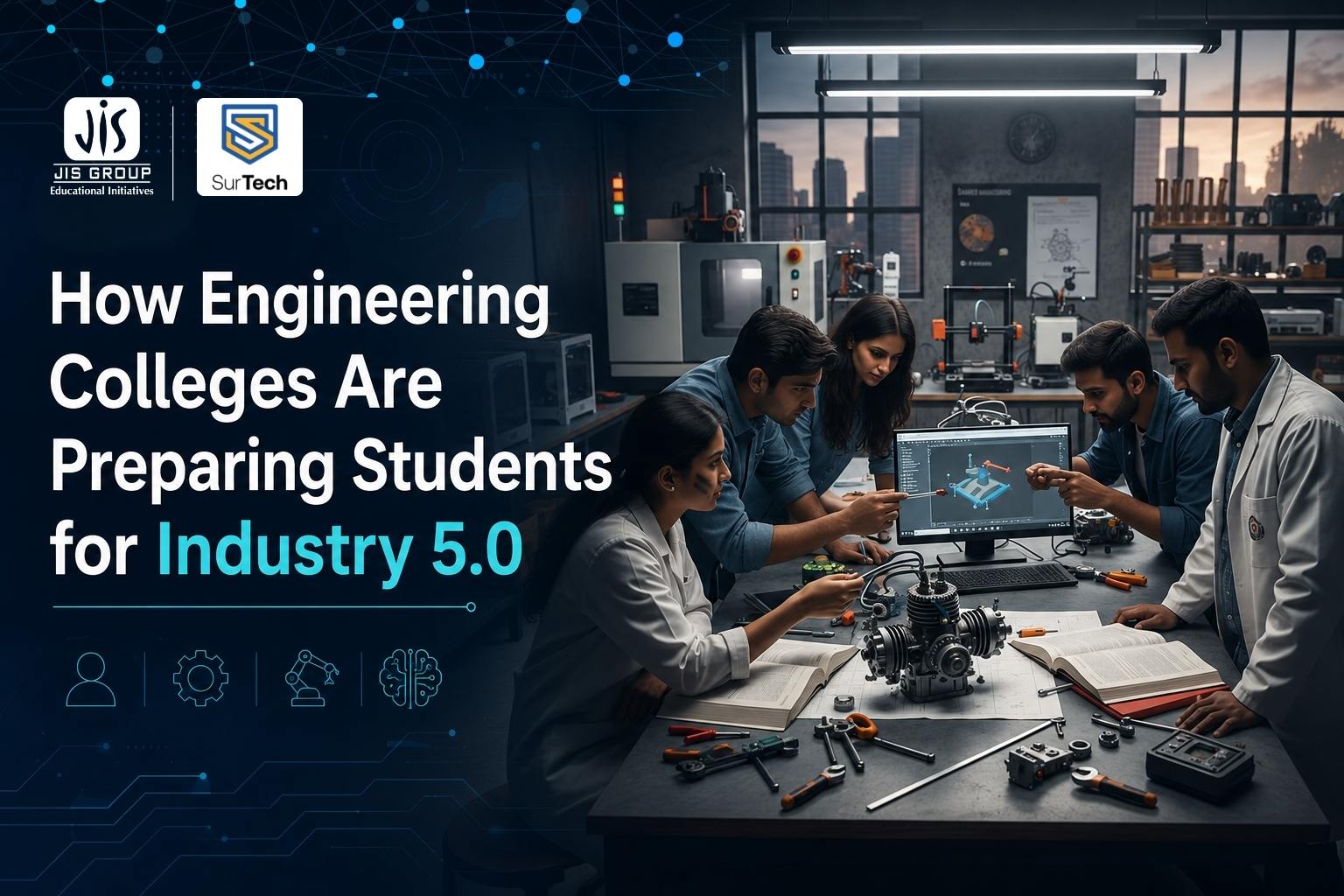
Engineering is changing along with the world around it. Earlier, engineering education mainly focused on technical knowledge, calculations, laboratory work and preparing students for established industrial roles. Today, that approach is no longer enough. Technologies such as artificial intelligence, robotics, automation, cloud computing and advanced data systems are changing how products are designed, manufactured and managed.
The next stage, often described as Industry 5.0, goes a step further. It focuses not only on technology and productivity but also on people, creativity, sustainability and resilience. For engineering students, this means learning how to work with advanced technologies rather than simply learning how those technologies work.
This shift is also influencing what students should look for when comparing the top engineering colleges in Kolkata. A strong engineering education today needs to combine fundamentals with practical learning, interdisciplinary thinking, digital skills and an understanding of real-world challenges.
What Is Industry 5.0?
Industry 5.0 is often described as the next development after Industry 4.0.
Industry 4.0 brought technologies such as automation, connected machines, the Internet of Things, artificial intelligence and data-driven manufacturing into industrial environments. Industry 5.0 builds on these developments but places greater emphasis on the relationship between people and technology.
Three ideas are particularly important:
-
Human-centricity
-
Sustainability
-
Resilience
Instead of imagining factories where machines simply replace people, Industry 5.0 focuses on collaboration between humans and intelligent technologies.
For engineering students, this creates a broader set of skills to develop.
Why Industry 5.0 Matters for Engineering Students
The workplace that engineering graduates enter may look very different from the one students see today.
An engineer may be expected to understand a technical system while also considering its environmental impact, safety, business value and effect on people.
This is why the top engineering colleges in Kolkata are increasingly expected to provide learning experiences that go beyond traditional classroom teaching.
Students need a combination of:
-
Strong engineering fundamentals
-
Digital and computational skills
-
Problem-solving ability
-
Communication
-
Creativity
-
Teamwork
-
Adaptability
-
Awareness of sustainability
The goal is not to turn every engineering student into a specialist in every emerging technology. Instead, students should develop enough technical and practical knowledge to keep learning as technology changes.
1. Greater Focus on Artificial Intelligence
Artificial intelligence is becoming relevant across engineering disciplines.
Mechanical engineers can encounter AI in predictive maintenance and robotics. Civil engineers can use data and digital systems for planning and monitoring. Electrical engineers work with intelligent control systems. Computer engineers naturally interact with machine learning, data and automation.
As a result, AI-related learning is becoming an important part of modern engineering education.
Students may be introduced to:
-
Machine learning
-
Data analysis
-
Computer vision
-
Generative AI
-
Intelligent automation
-
Predictive systems
The most useful approach is to learn these technologies alongside fundamental engineering concepts rather than treating them as isolated trends.
2. Learning Through Real Projects
Industry 5.0 is closely connected with solving real problems.
This makes project-based learning particularly valuable.
Instead of completing only theoretical assignments, students can work on projects involving sensors, software, robotics, automation, energy efficiency or data analysis.
A project might involve designing a smart monitoring system, developing an automated prototype or analysing data from a connected device.
This type of learning teaches students how to deal with practical issues such as:
-
Testing
-
Failure
-
Budget limitations
-
Team coordination
-
Time management
-
User requirements
When evaluating the top engineering colleges in Kolkata, students should therefore look at the kind of projects they can undertake during the course.
3. Human-Machine Collaboration
One of the defining ideas of Industry 5.0 is collaboration between people and intelligent machines.
Students therefore need to understand both sides.
They may learn how robots, automated systems and AI tools operate while also developing the human skills required to supervise, manage and improve those systems.
For example, an automated production system still requires engineers to:
-
Identify problems
-
Interpret information
-
Make decisions
-
Improve processes
-
Consider safety
-
Communicate with teams
Technology can process information quickly, but human judgement remains important.
4. Interdisciplinary Education
Industry 5.0 does not fit neatly into one engineering branch.
A modern product or system may involve software, electronics, mechanical design, data and business considerations at the same time.
This is why interdisciplinary projects can be valuable.
A computer science student might work with an electronics student to create an IoT system. A mechanical engineering student may collaborate with programmers on a robotic prototype.
Such projects help students understand how different areas of engineering connect.
When comparing the top engineering colleges in Kolkata, students can check whether the institution encourages collaboration between departments.
5. Sustainability Is Becoming Part of Engineering
Industry 5.0 also places greater attention on sustainable production and responsible use of resources.
Engineers increasingly need to think about energy consumption, waste, materials and environmental impact while designing products and systems.
Engineering education can introduce students to areas such as:
-
Renewable energy
-
Energy-efficient systems
-
Sustainable materials
-
Waste reduction
-
Green manufacturing
-
Environmental monitoring
This is not limited to environmental engineering. Sustainability can influence almost every branch of engineering.
A product that works well but wastes significant resources may not be considered an ideal solution in the future.
6. Industry Interaction and Expert Sessions
Classroom knowledge becomes more meaningful when students understand how it is applied in the workplace.
Industry interaction can expose students to current tools, workflows and professional expectations.
Engineering colleges may organise:
-
Guest lectures
-
Industry workshops
-
Expert talks
-
Technical seminars
-
Industrial visits
-
Live projects
-
Internship programmes
These experiences can help students understand what happens outside the classroom.
For students comparing the top engineering colleges in Kolkata, the quality and relevance of industry interaction can be an important factor.
7. Building Digital Skills Across Engineering Branches
Digital skills are no longer limited to computer science students.
A mechanical engineer may use simulation software. A civil engineer may work with digital modelling. An electrical engineer may use programming and intelligent control systems.
Engineering students can benefit from familiarity with:
-
Data analysis
-
Programming
-
Simulation
-
Digital modelling
-
Cloud platforms
-
IoT
-
Automation tools
The specific skills required will depend on the student's chosen branch and career direction.
The important point is to develop a willingness to work with digital tools rather than avoiding them.
8. Communication and Human Skills Still Matter
It may seem that Industry 5.0 is mainly about advanced technology, but human skills are becoming even more important.
Engineers often work in teams involving people from different technical and professional backgrounds.
A technically strong graduate may still struggle if they cannot explain an idea, present a solution or collaborate effectively.
Students should therefore work on:
-
Communication
-
Presentation
-
Leadership
-
Teamwork
-
Critical thinking
-
Creativity
-
Decision-making
These abilities complement technical knowledge.
9. Entrepreneurship and Innovation
Industry 5.0 can also create opportunities for students who want to develop their own products or businesses.
Engineering colleges can support innovation through:
-
Innovation labs
-
Incubation centres
-
Startup programmes
-
Hackathons
-
Prototype development
-
Entrepreneurship workshops
Students do not necessarily need to become entrepreneurs. However, learning how to identify a problem and develop a possible solution can improve their overall engineering mindset.
10. Preparing Students for Continuous Learning
Perhaps the biggest lesson from Industry 5.0 is that learning does not stop at graduation.
Technology changes too quickly for students to depend entirely on the knowledge gained during their degree.
A student graduating today may need to learn new software, programming frameworks, AI tools or industrial technologies several times during their career.
The top engineering colleges in Kolkata can help students prepare for this reality by encouraging independent learning, experimentation and curiosity.
Students should develop the habit of asking:
"What can I learn next?"
rather than thinking of graduation as the end of their education.
How Students Can Prepare for Industry 5.0
College provides the foundation, but students can take additional steps themselves.
They can:
-
Build practical projects.
-
Learn relevant programming languages.
-
Participate in technical competitions.
-
Take internships seriously.
-
Explore AI and automation tools.
-
Attend workshops and seminars.
-
Create a project portfolio.
-
Improve communication skills.
-
Follow developments in their engineering field.
-
Learn about sustainability and responsible technology.
These activities can make classroom learning more useful and help students understand their own interests.
What Should Students Look for in an Engineering College?
When comparing the top engineering colleges in Kolkata, students should look beyond rankings and advertisements.
A practical checklist includes:
-
Curriculum and electives
-
Faculty expertise
-
Laboratories
-
Project-based learning
-
Industry interaction
-
Internship opportunities
-
Research activities
-
Innovation facilities
-
Technical clubs
-
Infrastructure
-
Career guidance
-
Opportunities for interdisciplinary projects
No college will offer exactly the same experience to every student. The right choice depends on the student's engineering branch, interests, budget and career goals.
Final Thoughts
Industry 5.0 is changing the way we think about engineering careers. The future engineer is unlikely to work separately from technology. Instead, engineers will increasingly work alongside AI systems, robots, connected devices and automated processes while making decisions that require creativity, judgement and responsibility.
This makes modern engineering education broader than traditional technical training.
When researching the top engineering colleges in Kolkata, students should therefore ask a practical question: Will this college help me develop the knowledge, skills and mindset needed for a changing industry?
A strong foundation in engineering remains essential, but students also need opportunities to experiment, collaborate, solve practical problems and understand emerging technologies.
Industry 5.0 is ultimately about finding a better relationship between people, technology and the environment. Engineering students who understand all three can be better prepared for the opportunities and challenges of the coming years.